Scaling Simulation and Experimentation with VR-Forces, Orchestrate, and Hive
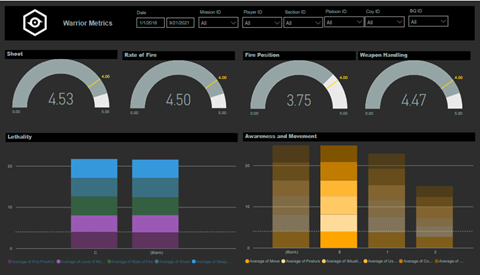
MAK’s partnership with Cervus began during the British Army’s Army Warfighting Experiment (AWE) in 2021. Working with ST Engineering Antycip, the teams integrated Cervus’ Hive analytics engine with VR-Forces to support real-time monitoring and after-action review.
That initial integration has grown into a broader approach that connects simulation, automated experimentation, and analytics to support training, wargaming, and force development.
Integration with VR-Forces
Cervus’ Hive plug-in connects directly to VR-Forces through its C++ API, collecting data in real time from running simulations. This data is passed into Hive, where it is translated into dashboards, charts, and comparative views. Because VR-Forces represents platforms, sensors, weapons, and environmental factors across domains, teams can capture detailed performance data at every level of a scenario, from force composition and laydown to behaviors and engagement outcomes. The result is a seamless pipeline from simulation execution to usable insight.
Scaling Experimentation with Orchestrate
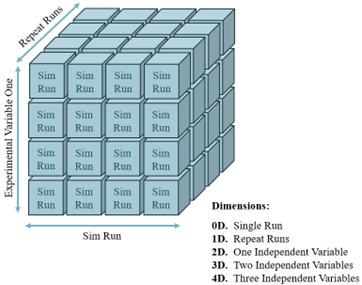
As experimentation requirements have expanded, Cervus’ Forge Orchestrate adds the ability to run simulations at scale. Instead of relying on a small number of manually executed scenarios, teams can design structured experiments with multiple variables and execute them in parallel across many runs. This makes it practical to test different force mixes, conditions, and assumptions in a controlled and repeatable way.
VR-Forces provides the simulation environment, while Orchestrate manages execution, turning experimental design into a large, usable data set.
Analytics with Hive
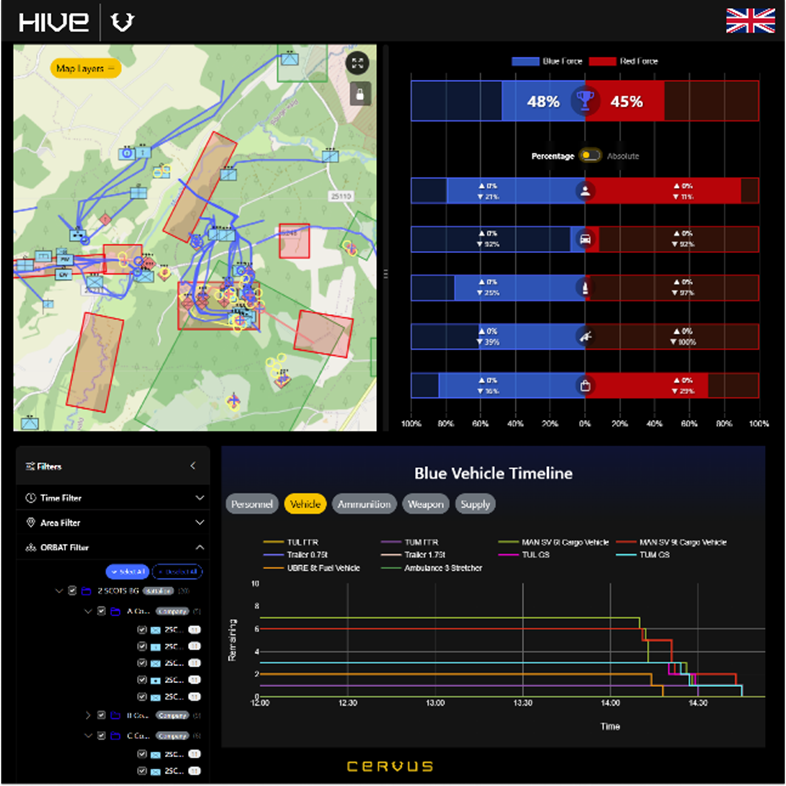
Hive provides the analytical layer that makes large-scale experimentation usable. It ingests simulation data and presents results through clear visualizations, allowing users to compare outcomes across runs, track performance metrics, and identify patterns. Machine learning capabilities help highlight trends, trade-offs, and points where additional investment yields diminishing returns.
This allows instructors, analysts, and decision-makers to move beyond reviewing individual runs and instead understand performance across a range of conditions.
Applications
This workflow supports a range of use cases:
- Training and exercise monitoring, with real-time feedback and structured debriefs
- Wargaming, with stronger analytical backing for outcomes
- Force development and experimentation, where multiple options can be tested and compared
- Operational analysis and research, supported by repeatable scenarios and measurable results
It also complements traditional wargaming by combining human-led exploration with structured, data-driven validation.
Together, VR-Forces, Forge Orchestrate, and Hive shift simulation from a single-run, observation-heavy process to one that is repeatable, scalable, and grounded in data.
Teams can explore more variables, produce results faster, and base decisions on patterns rather than isolated outcomes. For decision-makers, that means greater confidence in the conclusions drawn from experimentation and a clearer path from “what if” to actionable insight.
Read more about VR-Forces, Orchestrate, and Hive in this article, or check out Cervus' website.